
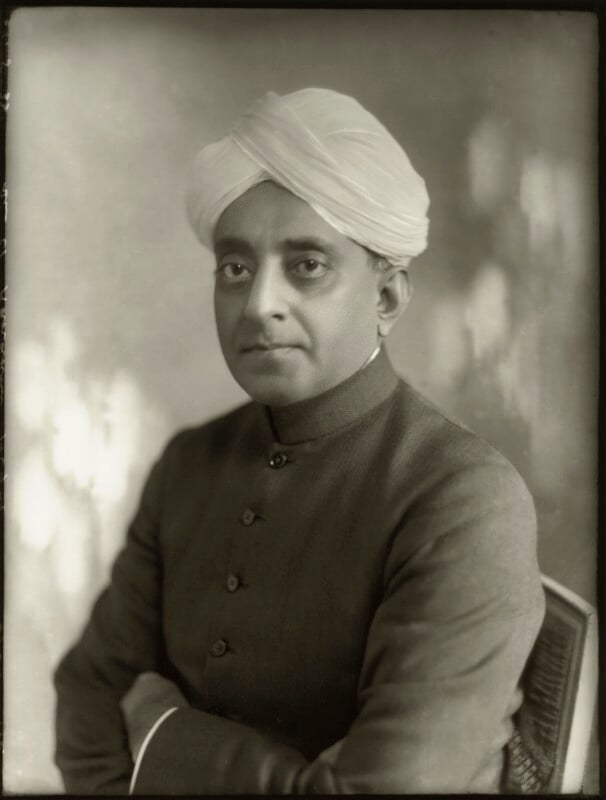
THE VANCHI POOR FUND – Presidential Address by Sir C.P. Ramaswami Iyer, Founder President, Vanchi Poor Fund (1943)
 vanchipoorfund1955@gmail.com
Published in 1993 Souvenir
Sir C.P. Ramaswami Iyer, then Dewan of Travancore and President of the Vanchi Poor Fund, made a stirring appeal to the citizens of the State to give their unstinted and steady support to the Vanchi Poor Fund, which, in the course of its first year, had done its best to earn their unqualified sympathy and help.
“It now devolves on me to wind up the proceedings of this meeting. I do so with mixed feelings. The first sentiment that comes to my mind is one of humility and diffidence before the vastness of the problem and its many ramifications. The second sentiment is one of profound satisfaction—satisfaction that within the space of a year, the call of the distressed has reached many, that the response has been gratifying, and a good beginning has been made.
Before I address myself to the details of a scheme which, with your leave, I shall put forward for your acceptance, let me make a few general observations. Not many days ago, I addressed the Chennapuri Annadana Samajam on its 50th anniversary. I paid a tribute to the unselfish but businesslike labours of my old friend Mr. Kanniah Chetty. Lest some of you may not have heard that speech or realized its implications, let me repeat some salient points. I pointed out that Mr. Kanniah Chetty retired on a modest salary as Manager of the Telegraphic Department. He was a man of limited means and humble origins, yet to him came the call of the blind, the aged, the halting, and the crippled. He decided that, to the extent possible, he should help that distress. He went among his neighbours, getting one anna from someone, just one plantain from another, and a leaf from a third. At the end of the day, if he got a quarter measure of rice, one plantain, and a leaf, he would call in those who could be fed with that and did so in his own home to start with. But from that day, he kept an account of each item, so that people began to trust him. When families held functions and wanted to feed people, they would tell him, ‘We shall feed eight and give you money to feed two.’ Gradually, this work grew from small beginnings into today’s Annadana Samajam with its own building, orphanage, and industrial school.
In my speech elsewhere I said that for work of this kind, money is not the first consideration. Throughout my life, I have found that men and women who spent large amounts on charitable enterprises did not start with money. They were not rich by wealth but were rich in the faculty of sympathy and in the rigid honesty that made them worthy trustees. I referred to my dear friend Dr. Besant: she would, on December 31st each year, take her cheque books and passbooks, see what she was worth, and distribute all of it, starting each new year as an absolute pauper. Yet, unsolicited donations would flow in throughout the following year, because people trusted in the inflexible honesty of her institutions and those who ran them. May I commend those examples to the Vanchi Poor Fund and its organizers?
Before I continue, it is my pleasure and privilege to announce to this meeting the hearty congratulations and good wishes of Their Highnesses the Maharaja and Maharani, who are associated with this institution and look forward to its continued growth. (CHEERS)
On a memorable occasion, the Rig Veda summarized all human duty in three words: Daya, Dama, and Dana. Dama means self-control, the curbing of destructive passions; Daya means mercy, not as lofty superiority, but as genuine fellowship; and Dana means sharing what you have—not out of patronage, but from a conviction that the happiness of the world is the common prerogative of every man and woman. This is not unique to India or Hinduism; for example, Islam commands a portion of income be set aside for distress relief, and Christianity—following the teaching of Jesus—praises charity above all.
I bring up these principles as they apply to our task in Travancore, affecting millions. If we become daunted by the enormity of the problem, nothing will be accomplished. The Vanchi Poor Fund is a humble step toward eradicating that evil. Currently, it is focused on two tasks: providing midday meals to poor pupils and enabling education. Children who attend school half-starved cannot benefit from learning. What is the pride in high enrollment if so many do not truly benefit? Our duty is to address this in education—primary, industrial, agricultural, and technical. Wise benefactors have shown in Scotland and in India that targeted philanthropy can transform society.
I do not appeal only to the rich. I would rather have a hundred thousand men giving two rupees each than two men giving a lakh, for each small contributor feels the urgency and acts on it. The point is that the people of Travancore should feed, educate, and clothe the poor of Travancore. If the State can help, it will, but its role is to provide elementary education for all. Meanwhile, let charity come from all, as it did in the flourishing days of the village community. Our ancestors made education and feeding a universal, collective responsibility.
Today, forms may change, but one thing to be avoided in charity is loftiness or patronage. The Vanchi Poor Fund’s aim must be to give as a brother to a brother, not in a way that diminishes the recipient’s dignity or personhood.
There are many benevolent institutions in this State. I suggest pooling their resources to create a strong, unified stream of relief. Every pie that goes to this Fund must be treated as a sacred trust, managed with business-like efficiency—lest benevolence founder on mismanagement.
In closing, I congratulate the organizers of the Vanchi Poor Fund, who have worked in the right spirit. The task is great, but if managed honestly and with deep community involvement, the Fund will help Travancore alleviate poverty and enable its people to live with dignity.
As a token of support, I hereby undertake to set apart Rs. 250 every month so long as I am in the State.”